Copper cables are expensive, and some electricians might recommend larger cable sizes than necessary. While upsizing cables can provide better efficiency and reduce voltage drop, it also increases costs. So, should you always opt for the biggest wire available?
For EV charging, the correct cable size depends on the charger’s power rating and installation conditions, such as surface mounting (in air) or concealed within walls or underground. Here are the recommended wire sizes based on IEC standards and best practices:
Recommended Cable Sizes for EV Chargers
• 7kW (Single-Phase) Charger → 6mm² cable (Standard)
• 11kW (Three-Phase) Charger → 6mm² cable (Although 4mm² meets the requirement per IEC 60364-7-722, we use 6mm² as standard for added safety and future-proofing)
• 22kW (Three-Phase) Charger → 6mm² cable (Standard for surface installations, but we recommend 10mm² if the cable is concealed within walls or buried underground)
Why Voltage Drop Matters?
Voltage drop occurs when electricity travels through a cable over a long distance, leading to power loss and reduced efficiency. If the voltage drop is too high, the EV charger may not function optimally, or in some cases, the charging speed may be reduced.
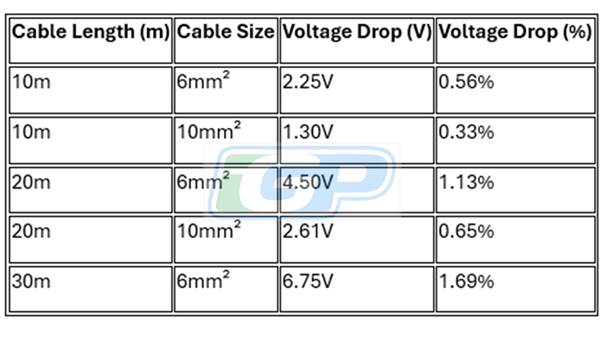
Here’s how voltage drop compares between 6mm² and 10mm² cables for a 22kW charger at different cable lengths, you can see a table attached with this post.
• 6mm² cable is sufficient for short to medium runs, but voltage drop increases significantly over longer distances.
• 10mm² cable keeps voltage drop lower, making it ideal for underground or concealed installations where heat dissipation is a concern.
• If the total voltage drop exceeds 2%, it is advisable to upgrade to a larger cable size to maintain charging efficiency.
Selecting the right cable size ensures safe and efficient EV charging while keeping costs reasonable. While 6mm² is our standard, we recommend 10mm² for 22kW chargers when cables are concealed or buried underground to minimize voltage drop and improve long-term reliability.