By Alvin Wong, CEO of Innovative Green Power Sdn. Bhd.
What Our Updated Poll Reveals About EV Charging in Malaysian Homes – And Why Strata Residents Still Face the Hardest Path
We recently ran a poll in our Home Charging Installation community with one simple question:
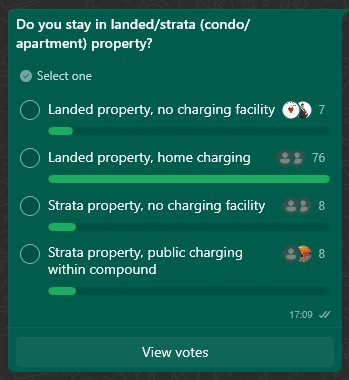
“Do you stay in landed or strata (condo/apartment) property?”
With the latest responses, the results are:
• 76 respondents (the majority) live in landed property with home charging
• 7 respondents live in landed property with no charging facility
• 8 respondents live in strata property with no charging facility
• 8 respondents live in strata property with public charging within the compound
These updated numbers give us a clearer picture of the current landscape:
• 83% of landed homeowners already have home charging
• 17% of landed homeowners do not have home charging yet
• 50% of strata residents have no charging access
• 50% of strata residents rely on shared/public chargers within the compound
This reinforces a truth we see every day in the field:
Home charging adoption is strong in landed homes, while strata properties remain the single biggest barrier to widespread EV charging in Malaysia.
To understand why, we must go beyond the statistics and examine the structural, technical, and regulatory challenges strata residents face. These are based on real cases we have handled across Malaysia.
________________________________________
1. Landed Homes: The Path of Least Resistance
The overwhelming number of landed homeowners with home chargers reflects one key reality:
Landed installations are straightforward, controllable, and immediate.
The workflow is simple and fully within the homeowner’s control:
1. Load assessment
2. Compliance with Suruhanjaya Tenaga wiring guidelines
3. Installation by certified installers
4. Energisation
No committees.
No building-wide implications.
No shared systems.
This is why landed homeowners continue to dominate early EV adoption.
________________________________________
2. Strata Living: Where Demand Exists but Approvals Lag Behind
In our updated poll, 16 residents live in strata properties:
• 8 have no access to charging
• 8 rely on shared/public chargers
This split illustrates how most strata communities are still in transition:
Some have started providing shared chargers, while many others remain stuck in the approval phase.
From our real-world experience, here are the main reasons strata residents still struggle to install EV chargers.
________________________________________
3. The Eight Structural Challenges Faced by Strata Residents
3.1 Multi-Layered Approval Processes That Slow Everything Down
Strata properties require approvals from:
• JMB or MC
• Property management
• M&E consultants
• TNB (for load impact review)
• Compliance with PLANMalaysia’s GPP EVCB
• Compliance with BOMBA’s EVCB guidelines
• Suruhanjaya Tenaga’s wiring and EVCS guide
Each party may place conditions or request clarifications.
Any change of committee members resets progress.
Because of this, a process that takes one week in a landed home can take six months or more in a condo.
________________________________________
3.2 Electrical Capacity is Often Insufficient or Unknown
Most high-rise buildings designed before the EV era struggle with:
• LV rooms near maximum load
• Limited spare ways on LVDBs
• Long cable routes leading to voltage drop
• Ageing switchgear that cannot safely accept additional load
• Limited or no three-phase availability in the car park
Even if TNB can supply more load, the building’s internal distribution system may not be ready without costly upgrades.
________________________________________
3.3 Cable Routing Obstacles Unique to High-Rise Structures
Routing a cable from a unit’s DB to the parking lot can be technically impossible due to:
• No continuous riser from unit to basement
• Fire compartmentation rules
• Structural beams that cannot be penetrated
• Height constraints in basements
• Missing or outdated as-built drawings
This is one of the strongest technical reasons MCs decline private chargers.
________________________________________
3.4 Liability, Insurance, and Fire Safety Concerns
JMBs and MCs must consider:
• Whether EV chargers affect building fire insurance
• Who is liable if a fault happens on common property
• Whether RCCB, MCB, SPD, and cables meet ST requirements
• Whether the building infrastructure can handle new loads safely
• Whether BOMBA’s fire safety guidelines are satisfied
Without certainty, committees choose caution over speed.
________________________________________
3.5 Confusion About EVCS Licensing Requirements
Suruhanjaya Tenaga’s position:
• Private chargers do not require an EVCS license
• Public or shared chargers operated by a CPO do require licensing
But many committees mistakenly believe:
• All chargers require licensing
• Installing a private charger triggers regulatory exposure
• Approving one charger means approving all future chargers
This misunderstanding leads to unnecessary delays.
________________________________________
3.6 Disagreements on Financial Models for Shared Chargers
Even when CPOs offer zero-cost installation, management struggles with:
• Revenue sharing
• Contract terms
• Parking allocation
• Billing and complaints management
• Long-term operational responsibilities
Lack of clarity slows momentum even when solutions are viable.
________________________________________
3.7 Internal Politics Among Residents
Social factors often outweigh technical factors:
• Non-EV owners feel EV owners are getting extra privileges
• Car park lot allocation becomes contentious
• Misconceptions about EV fire risks influence decisions
• Committee members fear backlash
Many technically sound proposals fail due to resident sentiment.
________________________________________
3.8 Heavy Administrative Burden on the Resident
Strata residents must:
• Prepare technical documents
• Present to committees
• Engage consultants
• Justify safety compliance
• Handle TNB and ST references
• Attend meetings
• Re-submit revised proposals
Many residents abandon the process due to fatigue.
________________________________________
4. What These Updated Poll Numbers Really Mean
The updated results tell a clear story:
Landed Homes
Home charging is mature, accessible, and already part of daily life.
Strata Homes
• Half have no charging at all
• Half depend on shared/public chargers
• Private unit-to-parking installations remain rare and difficult
This accurately reflects Malaysia’s current EV charging landscape:
Strata charging is the biggest challenge we must solve if Malaysia wants broad EV adoption.
________________________________________
5. Moving Forward: What Makes Strata Charging Possible
Despite these challenges, successful strata charging projects do exist — and they share the same foundations:
1. Correct load calculations
2. Compliance with ST wiring rules
3. TNB pre-consultation where needed
4. Transparent documentation for JMB/MC
5. A safety-first installation design
6. Proper protective devices and cabling
7. Installation by certified EV charger installers
With these conditions met, strata committees gain confidence, and approvals become smoother.
________________________________________
Our poll shows that Malaysia’s EV ecosystem is progressing, but unevenly.
Landed homeowners continue to lead because they control their infrastructure and decision-making.
Strata residents, however, face structural, technical, regulatory, and political barriers that make private EV charging complicated.
These challenges are not impossible to solve — but they require clarity, proper engineering, and structured processes. As the demand for EVs increases, enabling strata charging will be one of the most important steps in Malaysia’s transition to electrified mobility.
Safe and Reliable EV Charging Systems, one at a time.
WhatsApp us: https://wa.me/60125954786