By Alvin Wong, CEO of Innovative Green Power Sdn. Bhd.
When planning an EV charger installation, one question matters more than most: “How far is the charger from the distribution board (DB)?” That distance quietly determines how much voltage your charger receives — and how safely it performs for years to come.
At Innovative Green Power, we standardize every installation with 6 mm² full-copper cables as the minimum, and 10 mm² where higher loads or harsher conditions demand it.
Voltage Drop in Long Cables: Why Distance from DB to Charger — and Cable Size — Matters
1. Why voltage drop matters in EV charging
Voltage drop is the natural loss of voltage that occurs as electricity flows through a cable. The longer the cable or the higher the current, the greater the energy loss as heat.
For EV chargers drawing continuous current — sometimes for hours — even a small voltage drop can cause higher heat, slower charging, and wasted energy.
According to the Suruhanjaya Tenaga (ST) Guidelines for Electrical Wiring in Residential Buildings and IEC 60364-5-52, the maximum permissible voltage drop in any low-voltage circuit is 4 % of the supply voltage— roughly 9.2 V in Malaysia’s 230 V system.
2. The engineering standard: 6 mm² full-copper minimum
ST’s Guidelines on Electric Vehicle Charging System (2025) specify that every EV charger must be powered through a dedicated final circuit sized according to IEC 60364-5-52.
For most homes and condominiums, 6 mm² full-copper is the right balance of safety, performance, and compliance. It offers:
– Enough current-carrying capacity for continuous 32 A single-phase (7 kW) or 16 A three-phase (11 kW) chargers.
– Voltage-drop compliance even on moderate runs.
– Excellent thermal performance under Malaysia’s hot, humid conditions.
This makes 6 mm² the minimum standard for all professional installations — not an upgrade, but a safety requirement.
3. When to choose 10 mm² — and why
While 6 mm² covers most use cases, some conditions justify going one size up to 10 mm² full copper from the start:
– 22 kW three-phase chargers (≈ 32 A per phase) — the higher current demands thicker conductors for safe continuous duty.
– Full concealed wiring in concrete walls — reduced ventilation traps heat, so 10 mm² provides the necessary thermal margin.
– Long cable runs or high ambient temperatures — larger conductors reduce voltage drop and internal heating.
– Future scalability — if you plan to upgrade from 7 kW/11 kW to 22 kW later, installing 10 mm² now avoids re-wiring.
In simple terms:
– 7 kW or 11 kW charger → 6 mm² is usually enough.
– 22 kW charger or fully-concealed runs → start with 10 mm².
4. Why correct sizing matters more than “oversizing”
Using 10 mm² where it isn’t needed can create challenges:
– Many isolators, RCCBs and MCBs are rated for up to 6 mm² conductors. Larger cables may not fit without proper ferrules or upgraded terminals.
– Concealed conduits have space-factor limits (≈ 40 %); oversizing the cable may breach this rule or complicate pulling and bending.
– Bigger isn’t automatically safer if workmanship or containment isn’t adjusted accordingly.
That’s why IGP applies engineering judgement — upsizing where it adds safety, not merely thickness.
5. Real future-proofing: plan for 3-phase, not just thicker cable
If you intend to upgrade later to 11 kW or 22 kW three-phase, a single-phase cable won’t help. The correct way is to run a 5-core 6 mm² or 10 mm² copper cable from your DB, with matching isolator and conduit sizing. This ensures compliance today and flexibility for any 3-phase charger tomorrow.
6. IGP’s standard installation policy
– 6 mm² full-copper cable – baseline for all 7 kW (single-phase) and 11 kW (three-phase) chargers.
– 10 mm² full-copper cable – recommended for 22 kW chargers, fully-concealed routes in concrete, or runs beyond ≈ 20 m.
– Protection devices – Type A RCCB 40 A / 30 mA and MCB 40 A or as specified for three-phase.
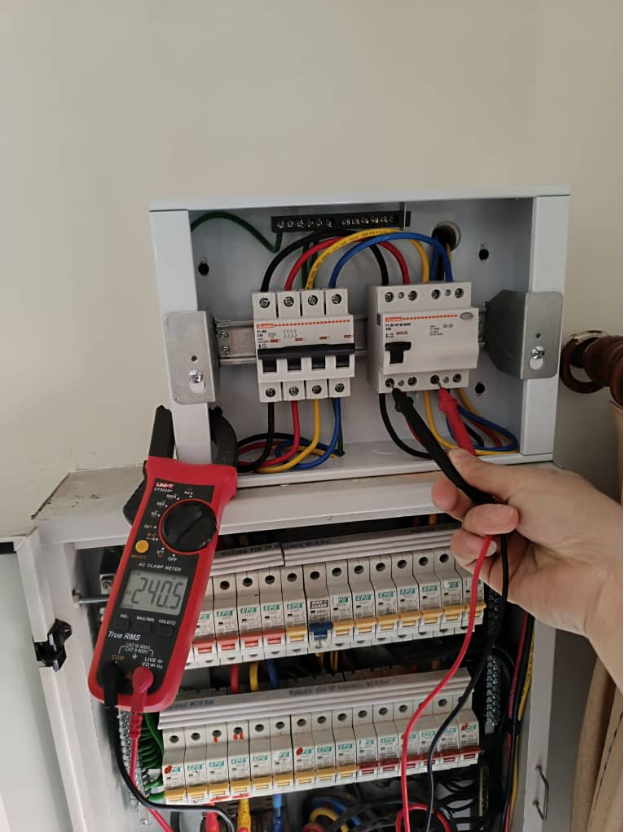
– Testing and verification – voltage-drop measurement during commissioning and thermal scan for concealed runs.
This standard gives homeowners confidence that every installation meets both safety and performance benchmarks.
Closing Thought:
Voltage drop may be invisible, but its impact isn’t. Undersized cables overheat and waste energy. Oversized cables without planning cause installation challenges.
The solution is balanced engineering. At Innovative Green Power, we calculate, verify, and test every circuit. 6 mm² keeps you safe. 10 mm² keeps you ready.
Safe and Reliable EV Charging Systems, one at a time.
WhatsApp us: https://wa.me/60125954786