We often hear the concern:
“7kW AC charging at home? Isn’t that too slow?”
But for most EV drivers in Malaysia — especially those living in landed homes with single-phase power — 7kW is not only enough, it’s more than sufficient. In fact, many homes operate just fine with 3.7kW charging, and anything more is a bonus.
Let’s break it down.
The Malaysian Routine: A > B > A
The daily pattern for most EV owners is simple:
Home > work > errands > home again.
This “A>B>A” routine usually totals around 30 to 80 km per day.
Even if you stretch that to 100 km daily, it still only eats up about:
• 15–20% of the battery on a BYD Atto 3
• 10–15% on a Hyundai Ioniq 5
• 20% or so on a Tesla Model 3 RWD
Which means… you’re not starting from empty each night. You’re just topping up what you used.
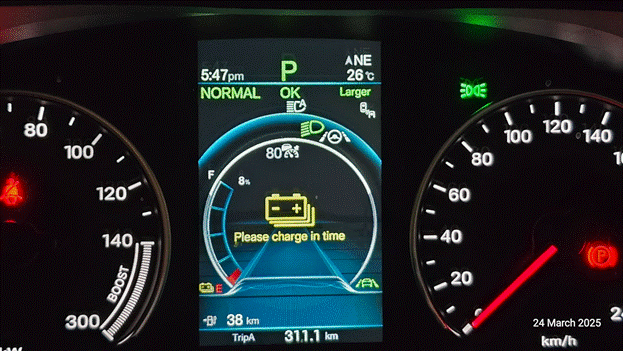
Real-World Charging Times
Here’s how long it takes to “refill” popular EVs with a 7kW AC home charger:
BYD Atto 3 Extended (60.5kWh battery)
• 7kW charger: Adds ~35–38 km of range per hour
• Full charge (0–100%): ~9 hours
• Typical nightly top-up (20–30%): 2–3 hours
Tesla Model 3 RWD (57.5kWh usable)
• 7kW charger: Adds ~40–45 km/hr
• Full charge: ~8.5 hours
• Nightly top-up: Often done in 1–3 hours
Hyundai Ioniq 5 Max (72.6kWh battery)
• 7kW charger: Adds ~30–35 km/hr
• Full charge: ~10.5 hours
• Nightly top-up: 3–4 hours easily cover 100+ km driven
So even if you’re only plugging in after dinner and unplugging before work — you’ll start your day with more than enough range.
What If You Don’t Have 7kW at Home?
Here’s the honest truth:
Most older Malaysian homes are wired for 32A single-phase, which technically supports up to 7.4kW — but only under ideal conditions.
Newer homes are often built with 63A single-phase, giving more headroom. But even then, your EV charger has to share the load with your water heater, oven, air conditioners, and other home appliances.
So in practice, your charger may be limited to 3.7kW or less, depending on how much the rest of your home is drawing.
And that’s perfectly fine.
At 3.7kW, you’re still adding:
• ~20 km of range per hour
• ~200 km overnight in 10 hours of charging
For most Malaysian drivers, that’s more than what you use in a week.
Need to Charge Faster Once in a While?
Let’s say you forgot to charge overnight or need to go on a long trip tomorrow. Unlike two years ago, high-powered public DC chargers are now widely available:
• Shopping malls
• Hotels
• Highway R&Rs
• Lifestyle hubs
So now, your backup plan is simple:
1. Top up 20–40% at a public DC charger in 20–30 minutes, and
2. Complete the rest slowly at home overnight
This hybrid approach gives you flexibility without stressing your home power supply.
Final Word
Charging an EV at home isn’t about speed. It’s about routine. Whether you’re running 3.7kW or 7kW, the real benefit is waking up every morning with your car ready to go.
And unless you’re doing 300 km a day (which is rare), home charging — even at lower speeds — is more than enough.