By Alvin Wong, CEO of Innovative Green Power Sdn. Bhd.
“Your wires are hot, you need to upgrade them…” they say.
But is that really true?
I hear this often on EV charger jobs. It sounds sensible—hotter wires, bigger cable, problem solved—but that’s not how a safe electrical design works.
Let’s unpack this properly, based on Malaysia’s actual standards and what we see in the field.
First, let’s get the load numbers right (Malaysia context)
When you charge an EV at home:
• Single-phase chargers (230 V) drawing ~32 A are roughly 7.4 kW.
• Three-phase (400 V) at ~16 A/phase is roughly 11 kW.
• Three-phase (400 V) at ~32 A/phase is roughly 22 kW.
Those are the typical EV charging points people talk about at home and small sites. Malaysia’s nominal supply is 230/400 V, 50 Hz (TT or TN-S systems), and all designs should be done against that baseline.
Warm ≠ wrong. Hot spots usually mean something else.
Cables can feel warm under sustained load. That alone doesn’t mean the wire is too small. In our installations, 6 mm² full-copper is commonly used for 7.4 kW single-phase and 11 kW three-phase—when the design, installation method, protection, and terminations are done correctly. Malaysia’s domestic wiring guideline requires you to size cables using the IEC 60364 tables (current-carrying capacity, installation method/derating, and voltage-drop), not guesses.
So why do some setups run hot?
1) Loose or poor terminations
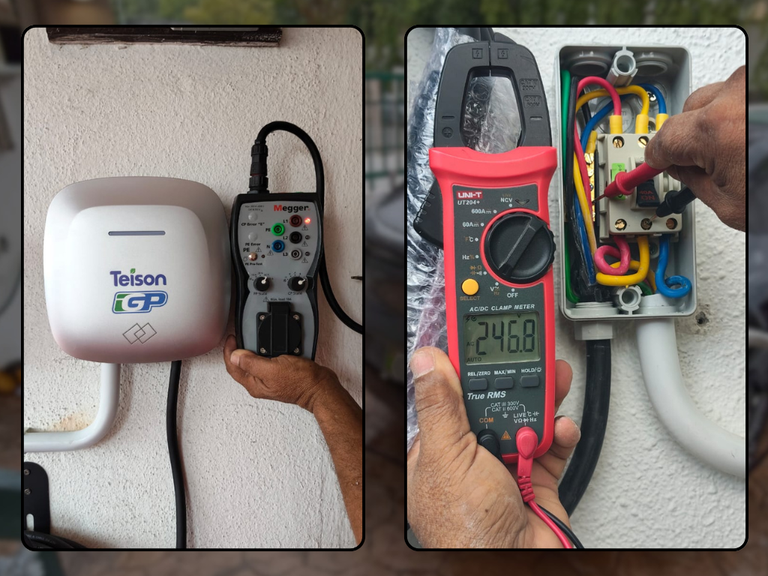
Even slightly loose screws at the MCB, RCCB, or inside the charger create resistance → heat. Proper tightening and, if needed, re-termination are part of the required inspection and testing before handover.
2) Ordinary components in a continuous-duty application
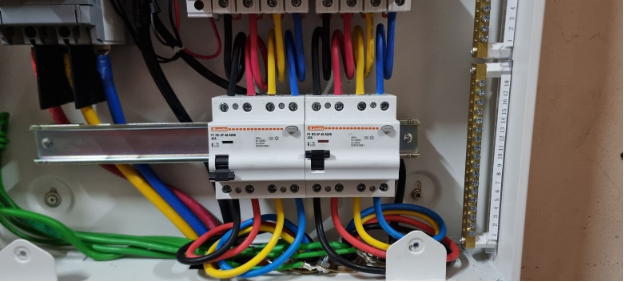
EV charging is continuous load for hours. Two breakers can both be compliant, yet behave differently under long, high duty. Higher-grade devices typically have larger contact surfaces, stronger springs, and better heat handling. At IGP we go beyond basic compliance and specify protection gear built for sustained current, because it runs cooler and lasts longer in real use.
3) Workmanship: lugs, crimps, and oxidation
A crushed/under-crimped lug or oxidised surface can create a local hot spot even if the rest is perfect. Good practice (correct lugs, correct torque, clean metal) matters.
4) Environment and routing
Cables inside insulation, hot roof spaces, tightly bundled conduits, or long runs change the math. The guideline expects you to apply derating and voltage-drop checks and adjust design accordingly (route change or upsizing).
When is upsizing to 10 mm² actually warranted?
• Long runs that fail the allowable voltage-drop limits.
• High ambient / insulated routes / grouping that require derating beyond what the current cable/method supports.
• Future expansion (e.g., planning for ~22 kW three-phase).
• Measured non-compliance after fixing terminations and verifying devices (e.g., unacceptable temperature rise or test failures).
Otherwise, upsizing “just because it feels warm” adds cost and stiffness without solving the root cause.
What Malaysian rules expect (plain-English summary)
• Design & sizing: Use competent persons to calculate maximum demand, diversity, installation method, derating, and voltage-drop per the domestic wiring guideline (which references IEC 60364).
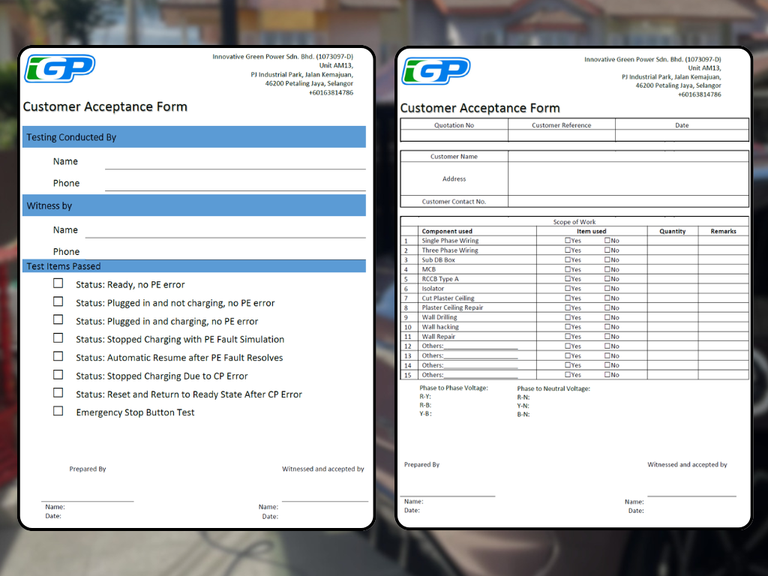
• Inspection & testing: Before service, perform the required tests (continuity, insulation resistance, polarity, RCD trip, earth-loop, etc.). These catch loose/poor terminations—the most common heat source.
• Supply context: Work to Malaysia’s 230/400 V, 50 Hz LV system and utility interface defined in TNB’s handbook, alongside ST rules.
Bottom line is if someone tells you, “Your wires are hot—upgrade the cable,” pause and ask:
• Have the terminals been checked and re-torqued?
• Are the protection devices suitable for continuous duty, not just minimally compliant?
• Has voltage-drop and derating been calculated for the exact route and environment?
If those are in order, a properly designed and installed 6 mm² circuit can be entirely appropriate for 7.4 kW single-phase or 11 kW three-phase charging. If they’re not, fix the connections/components first; upsize only when the calculations and tests say so.
At Innovative Green Power, we don’t oversize for show. We design to Malaysia’s standards, test thoroughly, and specify components for continuous EV duty—because endurance and safety come from engineering, not guesswork.
Safe and Reliable EV Charging Systems, one at a time.
WhatsApp us: https://wa.me/60125954786