By Alvin Wong, CEO of Innovative Green Power Sdn. Bhd.
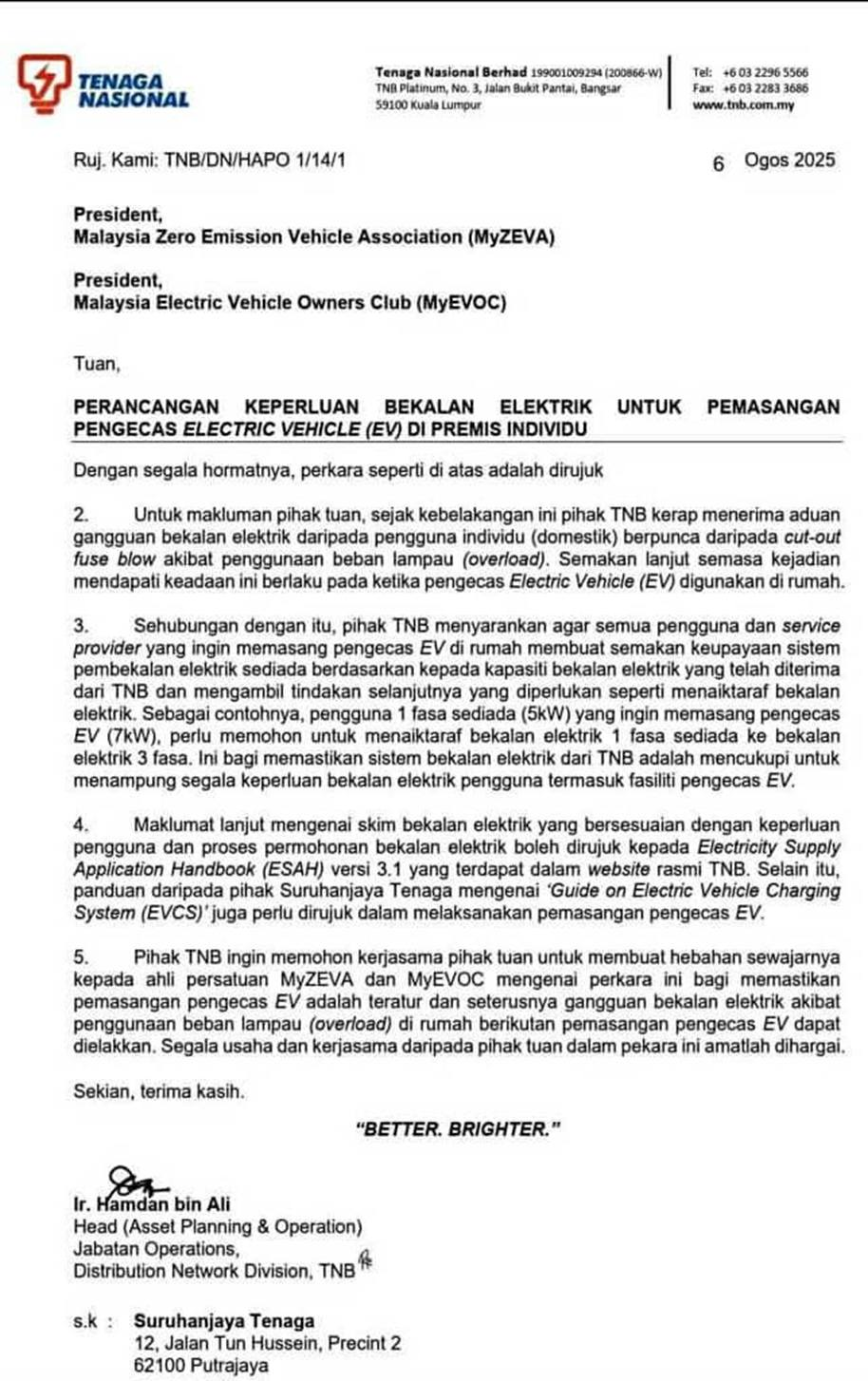
We have been asked repeatedly since a TNB letter was disclosed to the public regarding whether single-phase homes in Malaysia can safely support 7 kW home EV chargers, and what the actual regulatory and technical limits are under TNB and Suruhanjaya Tenaga (ST) frameworks.
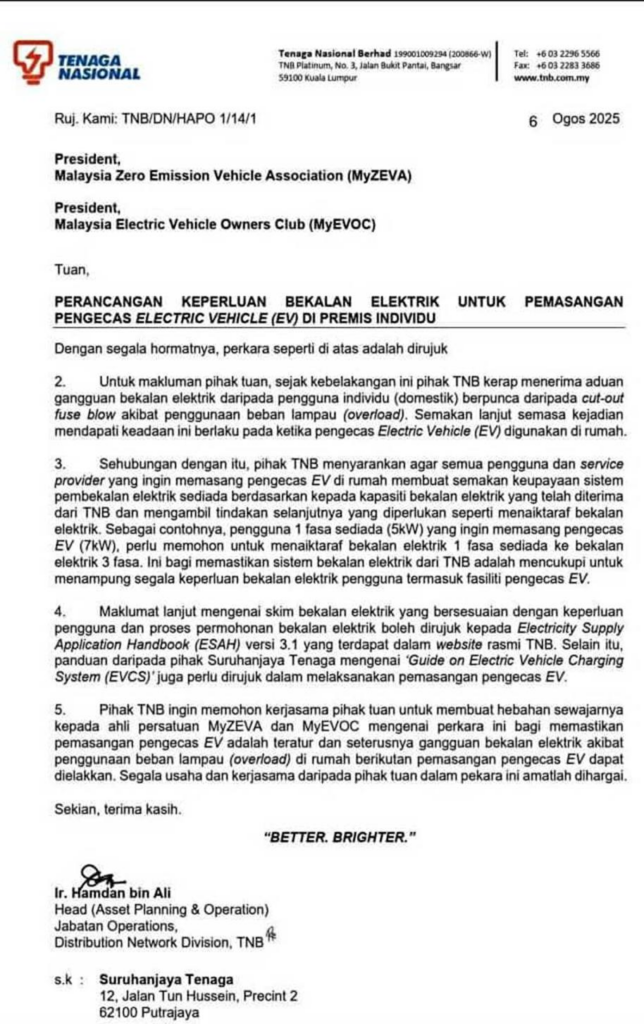
This statement provides a complete, regulation-based explanation aligned with the Electricity Regulations, ESAH 3.1, and IGP’s safety-first installation practices.
________________________________________
1. Understanding the TNB Letter
The TNB letter highlights rising cases of:
• blown 32 A cut-out fuses
• supply interruptions
• overheating at overhead joints and couplers
in homes where EV chargers were added without verifying supply adequacy or maximum demand.
These issues reflect requirements already found in:
• Electricity Regulations 1994 – Regulation 11 (approval for extensions)
• Electricity Regulations 1994 – Regulation 36 (adequate overcurrent and earth leakage protection)
• ESAH 3.1 – Maximum Demand (MD) planning and supply scheme requirements
• ST’s Guidelines for Wiring in Residential Buildings – requirement to calculate MD and design accordingly
• ST’s Guide on Electric Vehicle Charging System (EVCS) – installer responsibility to verify load adequacy
The TNB letter does not introduce new rules.
It simply reinforces existing, mandatory compliance requirements.
________________________________________
2. Theoretical 6.3 kW vs Real-World Conditions in Malaysian Homes
Many homeowners calculate:
32 A × 230 V ≈ 7.36 kW
After derating for continuous load ≈ 6.3 kW
This is technically correct only under ideal conditions, where:
• conductors are new
• terminations are tight
• insulation is intact
• voltage is stable
• ambient temperature is controlled
• there is no corrosion or fatigue
However, ST’s Wiring Guidelines state that maximum demand must be calculated based on actual site conditions and conductor thermal capability, not theoretical nameplate ratings.
Most Malaysian homes, especially those 15–30 years old, do not meet these ideal assumptions.
________________________________________
3. TNB Overhead Conductors: The Real Limiting Factor
Many landed homes in Malaysia are supplied via LV overhead lines using aluminium conductors.
Based on field inspections since 2022, we commonly see:
• 10 mm² aluminium in older neighbourhoods
• 16 mm² aluminium in standard developments
• 25 mm² aluminium in some upgraded or heavier-load areas
While 25 mm² aluminium offers better current-carrying capability, the weakest points are not the conductors themselves, but the:
• aged couplers
• neutral links
• mechanical joints
• looping (daisy-chained) configurations
• long overhead distances with voltage drop
These components exhibit increased resistance and heat under long-duration EV charging, which is a continuous load lasting several hours.
This is why the real usable continuous current capacity of older domestic areas is often significantly lower than the theoretical 6.3 kW.
________________________________________
4. What ESAH 3.1 Actually States About Maximum Demand (MD)
TNB’s Electricity Supply Application Handbook (ESAH) 3.1 provides the official MD values used for supply planning.
A. MD Range for Typical Domestic Homes
(Table 2-1 – Domestic Premises)
• Double-storey terrace/apartment: 3–5 kW
• Single-storey semi-detached: 3–7 kW
• Double-storey semi-detached: 5–10 kW
• Bungalows/luxury condos: 7–15 kW
These MD values represent the entire home’s expected peak load, not including EV charging, because most homes were designed and built before EVs existed.
B. MD Limit for 230 V Single-Phase Supply
(Table 3-1 – Minimum Supply Schemes)
• Up to 12 kVA (≈12 kW) → Supplied using 230 V single-phase
This means a single-phase home cannot exceed 12 kW MD under TNB supply rules.
In practice, many homes do not achieve 12 kW safely due to ageing infrastructure.
C. MD Limit for 400 V Three-Phase Domestic Supply
• Up to 100 kVA → Supplied using 400 V three-phase
This makes three-phase the correct platform for sustained EV charging above 5–6 kW.
________________________________________
5. Why a 7 kW Charger Is Not Automatically Safe for Single-Phase Homes
A 7 kW charger is a continuous load, typically drawing power for 2–6 hours.
Continuous loads stress conductors and terminations far more than intermittent appliances.
Risk factors include:
• thermal fatigue at overhead couplers
• voltage drop on aluminium lines
• deterioration of insulation
• heating of DB busbars and neutral links
• cut-out fuse overheating
• loose terminations on older boards
IGP has documented real overheating cases, including melting couplers in older daisy-chained networks, even when the theoretical currents were within limits.
This is why practical safe capacity for many older single-phase homes is closer to 5–6 kW, not 7 kW.
________________________________________
6. Safety-First Position Consistent With All Regulations
After reviewing:
• ESAH 3.1 MD limits
• Electricity Regulations 1994 (Reg. 11 and Reg. 36)
• ST Wiring Guidelines
• ST EVCS Guide
Our professional conclusion is:
If you intend to charge consistently above 5–6 kW at home, a three-phase upgrade should be seriously considered.
This recommendation ensures:
• compliance with MD calculations
• compliance with supply scheme rules
• lower risk of overheating
• protection for neighbours sharing the same LV feeder
• long-term safety of the home’s electrical system
The 5–6 kW range provides the necessary safety margin for older infrastructure and real-world conditions.
________________________________________
7. What Innovative Green Power Does Before Installing Any EV Charger
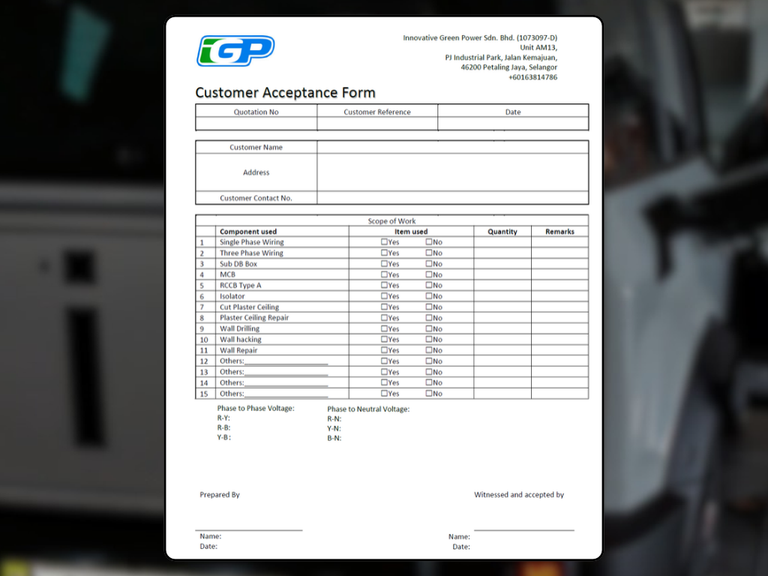
We do not approve or install a home EV charger without completing:
1. TNB incoming supply inspection
2. Assessment of overhead conductor size and condition
3. MD calculation as required by ESAH 3.1
4. DB and wiring inspection against ST standards
5. Earth leakage protection verification (RCD/RCCB)
6. Recommendations for load limiting or three-phase upgrade where required
This is mandatory to ensure a safe, legal, and robust charging setup for homeowners.
________________________________________
8. Summary for Malaysian Homeowners
• The TNB letter does not create new rules; it reinforces existing compliance requirements.
• A 7 kW charger is not automatically safe on any single-phase home.
• Theoretical 6.3 kW calculations do not represent real-world ageing electrical conditions.
• ESAH 3.1 places single-phase homes in the ≤12 kW MD category, but practical safe capacity is often lower.
• Three-phase supply offers far higher MD headroom and safer long-duration charging.
• Continuous EV charging must be evaluated using actual site conditions, not theoretical numbers.
At Innovative Green Power:
We install only what your home can safely and legally support.
We prioritise electrical safety above charging speed.
– Alvin Wong, Director and CEO, Innovative Green Power
Safe and Reliable EV Charging Systems, one at a time.
WhatsApp us: https://wa.me/60125954786