1. Introduction
Every EV charger installation requires residual current protection. But should you use a Type A or Type B residual current circuit breaker (RCCB)? Choosing the right device ensures safety, compliance and protects your charger and home.
2. What Does an RCCB Do?
An RCCB (or RCD) detects leakage currents between live conductors and earth. If there is a fault—such as damaged insulation or contact with water—it disconnects power to prevent electric shock. Malaysian EVCS guidelines require a 30 mA RCCB or RCBO in every EV charger circuit.
3. Type AC, Type A and Type B – What’s the Difference?
- Type AC: Designed to detect residual pure AC currents. It cannot detect pulsating DC or smooth DC leakage. Because EV chargers use rectifiers that can produce DC components, Type AC RCDs are not suitable for EV charging.
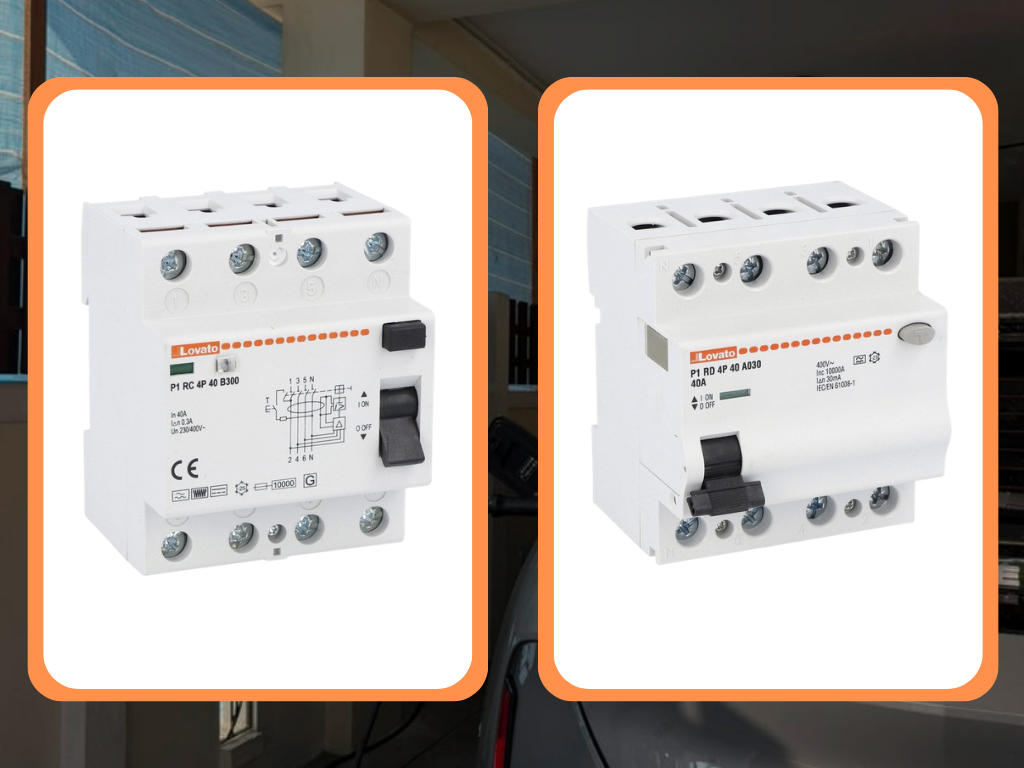
- Type A: Detects residual AC currents and pulsating DC up to 6 mA. This makes Type A suitable for most single-phase EV chargers, which have built-in DC leakage protection up to 6 mA. ST guidelines typically require Type A at minimum.
- Type B: Detects AC, pulsating DC and smooth DC currents. It is used when the EV charger does not have built-in DC leakage detection or for certain three-phase chargers and high-power applications.
4. When Is Type A Enough?
Modern home chargers usually include a 6 mA DC leakage detection device (often called an A-EV or 6 mA DC module). This satisfies EVCS requirements so a Type A RCCB provides sufficient protection. It detects AC and pulsating DC leakages, and the charger monitors DC leakage internally. IGP’s Smart Mini Home Charger incorporates 6 mA DC leakage protection, meaning you need only a Type A RCCB.
5. When Do You Need Type B?
A Type B RCCB becomes necessary if:
- Your charger lacks built-in DC leakage detection. Without this feature, DC fault currents could blind a Type A device.
- You are installing a three-phase 22 kW charger or certain commercial chargers that may produce higher DC leakage.
- You connect to chargers designed for industrial settings, which often require Type B protection.
Type B devices are more expensive but provide comprehensive protection against smooth DC faults.
6. Avoid Type AC for EV Chargers
Type AC RCCBs cannot detect DC components and are therefore unsuitable for EV charging. Installing Type AC can leave DC faults undetected, potentially causing electric shock hazards. Always insist on at least Type A or Type B for EV chargers.
7. IGP’s Recommendations
We adhere to Suruhanjaya Tenaga guidelines requiring Type A RCCBs or RCBOs for residential EV chargers with 6 mA DC leakage detection. For higher-power chargers without internal DC detection, we use Type B RCCBs. We always verify the charger’s specifications before selecting the RCD. Our standard installation packages include properly rated RCDs and overcurrent protection in a dedicated distribution box.
8. Conclusion
Choosing between Type A and Type B RCCBs depends on your charger’s internal protection. For most home installations, Type A is sufficient because modern chargers incorporate 6 mA DC leakage detection. Type B is necessary only when the charger lacks this feature or for certain three-phase systems. Never use Type AC for EV charging. With IGP’s expertise, you can be confident that your installation meets Malaysian safety standards and uses the correct RCD.