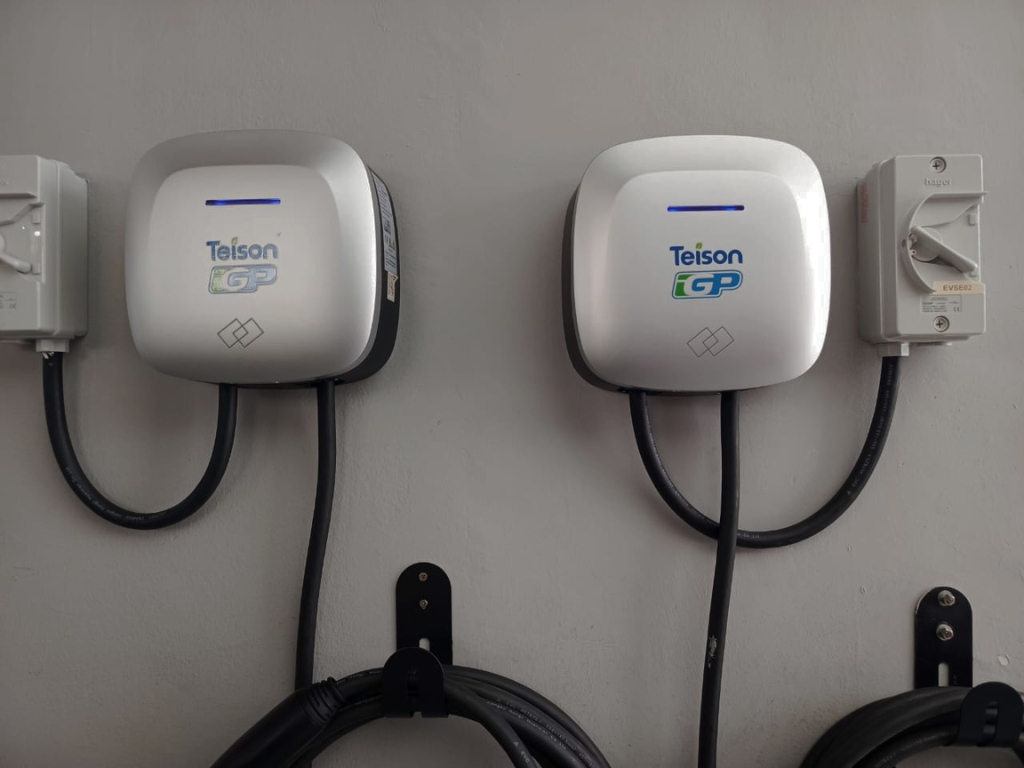
Once EV owners begin planning their home charging setup, one of the first questions they face is:
“Which charger should I buy?”
At first glance, many chargers appear very similar. Most are rated around 7kW for single-phase homes, and many products look nearly identical in brochures.
However, the power rating alone does not tell the full story.
In reality, the difference between a basic charger and a truly smart charger can significantly affect how safely and reliably the system operates in a home environment.
Understanding these differences helps homeowners make better long-term decisions.
Not All EV Chargers Do the Same Job
At its simplest level, an EV charger supplies electricity to the vehicle.
But a modern home charging system must do more than simply deliver power.
A well-designed charger should also be able to:
- Monitor electrical conditions
- Manage power safely
- Communicate with the vehicle
- Adapt to the home’s electrical capacity
These functions are particularly important because EV charging is classified under IEC 61851-1 as a continuous electrical load, meaning the system can operate at high current for several hours.
Without intelligent management, this continuous load can place unnecessary stress on the home’s electrical system.
The Role of Smart Charging
Smart EV chargers are designed to manage charging intelligently rather than simply supplying maximum power.
This allows the charger to adapt to the conditions of the home and the electrical system.
Smart charging capabilities may include:
- Dynamic load balancing
- Adjustable charging current
- Remote monitoring
- Scheduled charging
- Energy management features
These functions allow the charger to operate efficiently while protecting the home’s electrical system.
Why Dynamic Load Balancing Matters
One of the most useful features in a smart charger is dynamic load balancing (DLB).
Many Malaysian homes operate on single-phase supply, where several appliances may run at the same time.
For example:
- Air conditioners
- Electric ovens
- Water heaters
- EV chargers
When multiple high-power appliances run simultaneously, the total load can approach the home’s electrical limits.
Dynamic load balancing allows the charger to monitor the overall household consumption and automatically adjust the charging current when necessary.
Instead of pushing the system to its limits, the charger adapts intelligently.
This feature improves both safety and stability.
Smart Chargers Help Future-Proof the Home
Another advantage of smart chargers is their ability to adapt to future changes in the home’s energy system.
As more households adopt technologies such as:
- solar photovoltaic systems
- battery storage
- multiple EVs
Energy management within the home becomes increasingly important.
Smart chargers can integrate into these systems more effectively, allowing homeowners to optimise how electricity is used.
Charger Selection Should Match the Home
Choosing an EV charger should not be based solely on the charger’s power rating.
Instead, the charger should match the electrical characteristics of the home, including:
- electrical capacity
- distribution board configuration
- household load patterns
- future energy needs
This is why charger selection is often done together with the home inspection process.
Once the electrical system is understood, the most appropriate charger can be recommended.
A Charger Is Only Part of the System
It is also important to remember that the charger itself is only one part of the overall EV charging system.
A complete installation involves:
- appropriate cable sizing
- proper protection devices
- isolation switches
- correct installation design
Even the best charger will not perform well if the surrounding electrical system is not properly designed.
For this reason, charger selection and installation planning should always go hand in hand.
Making the Right Choice Early
Choosing the right charger early in the EV ownership journey simplifies the entire process.
When the charger is selected together with the installation plan, homeowners gain clarity on:
- system capability
- installation requirements
- overall charging performance
This allows installation to be scheduled efficiently once the vehicle delivery date is confirmed.
Preparing early ensures that the charger is ready when the EV arrives.
IGP’s Safety Principle
IGP enforces high standards as a deliberate benchmark to maximise safety in residential EV charging.
Because a home is not just an electrical installation—it is where lives and livelihoods are protected.
EV charging should be an upgrade to modern living, not a compromise in safety.
Let our obsession with quality protect your safety.
Because when it comes to EV charging and electrical systems, there’s no room for compromise.
Need your EV charger or electrical setup professionally inspected?
📞 WhatsApp Us: https://wa.me/60125954786
Stay connected with us:
🔹 Instagram: https://www.instagram.com/InnovativeGreenPowerMY
🔹 Facebook: https://www.facebook.com/innovativegreenpower
🔹 YouTube: https://www.youtube.com/@IGPEVCharging-ir8rv
🌍 Website: https://www.innovativegreenpower.com