By Alvin Wong, CEO of Innovative Green Power Sdn. Bhd.
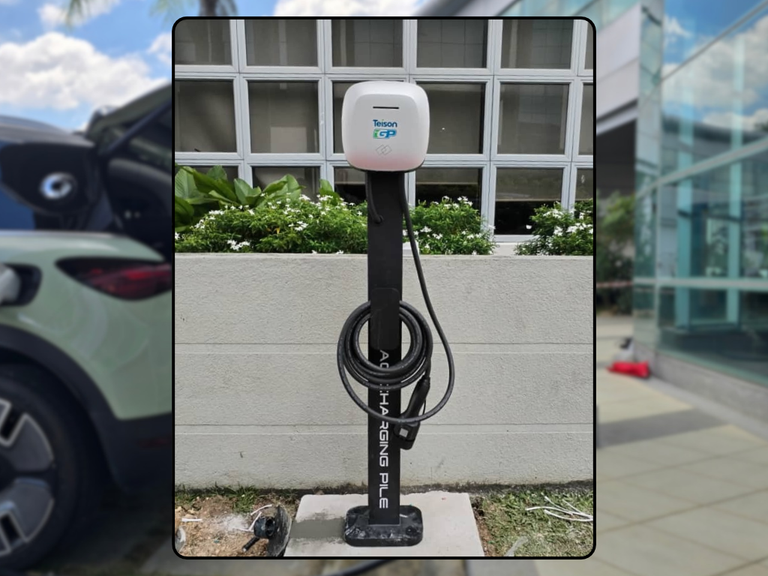
For 7 kW home EV chargers in Malaysia, one technical requirement appears consistently across guidelines, standards, and competent installations:
A minimum 6 mm² copper supply cable is required.
This is not an arbitrary installer decision, nor a “best-practice upgrade”. It is the result of how EV charging is classified, evaluated, and regulated under Malaysian and international electrical standards.
This article explains why 6 mm² is treated as the minimum, and how that requirement is derived from verifiable guidelines.
1. A 7 kW EV Charger Is a Continuous Electrical Load
A 7 kW single-phase EV charger typically operates at:
- Nominal voltage: 230 V
– Rated current: ≈ 32 A
– Operating duration: Multiple hours without interruption
Under IEC 61851-1 (Electric Vehicle Conductive Charging System), EV charging equipment is designed for continuous operation at rated current.
Why this matters
Electrical standards apply stricter conductor sizing rules to continuous loads than to intermittent household appliances.
2. Continuous Loads Trigger Higher Cable Sizing Requirements
Under MS IEC 60364 and IEC 60364-5-52, conductors supplying continuous loads must be selected such that:
– Thermal limits are not approached during normal operation
– Insulation ageing is controlled over the service life
– Voltage drop remains within prescribed limits
Unlike air-conditioners or ovens, EV chargers:
– Do not cycle off
– Maintain near-constant current
– Generate sustained conductor heating
This fundamentally changes the cable sizing baseline.
3. Malaysian Voltage Drop Limits Reinforce the 6 mm² Requirement
The Suruhanjaya Tenaga Guidelines for Electrical Wiring in Residential Buildings, aligned with MS IEC 60364, limit voltage drop to:
Maximum 4 % of nominal supply voltage
For a 230 V system:
Maximum allowable drop ≈ 9.2 V
At 32 A continuous current, voltage drop becomes a limiting factor well before thermal limits in real installations, especially when:
- Cable routes exceed short distances
– Conductors are installed in conduits
– Ambient temperatures are elevated (as in Malaysia)
A 6 mm² conductor provides the margin needed to stay within this regulatory limit under practical conditions.
4. Installation Conditions in Malaysia Cause Cable Derating
IEC 60364-5-52 requires current-carrying capacity to be derated based on:
- Installation method (conduit, trunking, concealed)
– Grouping with other circuits
– Ambient temperature
In Malaysian residential environments:
– EV charger cables are rarely free-air installed
– Conduit installations are common
– Roof spaces and walls are thermally stressed
These factors reduce the effective ampacity of smaller conductors, making 6 mm² the minimum size that remains compliant after derating.
5. Why 4 mm² Does Not Meet Guideline Intent
While 4 mm² copper conductors may appear to carry 32 A under ideal laboratory conditions, standards are written for:
– Worst-case operating conditions
– End-of-life insulation performance
– Cumulative thermal stress
Guidelines do not assess whether something “works today”, but whether it remains safe and compliant over years of continuous EV charging.
Under Malaysian installation realities, 4 mm² fails to provide sufficient margin once:
– Continuous load factors are applied
– Voltage drop is calculated properly
– Thermal derating is accounted for
6. Alignment with TNB Supply Assessment Principles
The TNB Electricity Supply Application Handbook (ESAH 3.1) emphasises that:
– Conductor sizing must reflect actual maximum demand
– Voltage quality must be maintained at the point of utilisation
– Installations must not introduce long-term stress to the distribution system
Using 6 mm² conductors aligns the EV charger circuit with these principles, particularly for sustained high-current loads.
7. Why Guidelines State 6 mm² as the Minimum
Taken together, the requirement for a minimum 6 mm² cable is derived from:
– EV charging classified as a continuous load (IEC 61851-1)
– Continuous loads requiring enhanced conductor sizing (MS IEC 60364 / IEC 60364-5-52)
– A strict 4 % voltage drop limit (ST Residential Wiring Guidelines)
– Mandatory derating under Malaysian installation conditions (IEC 60364-5-52)
This is not an installer preference — it is the logical outcome of applying the standards correctly.
8. How You Can Verify This Yourself
Readers can independently reference:
– IEC 61851-1 – EV charging characteristics
– IEC 60364-5-52 – Cable sizing and derating
– MS IEC 60364 – Electrical installations of buildings
– Suruhanjaya Tenaga – Guidelines for Electrical Wiring in Residential Buildings
– TNB ESAH 3.1
All are established regulatory or standards documents used by electrical professionals in Malaysia.
Final Takeaway
The reason EV charging guidelines require 6 mm² as the minimum cable size for 7 kW chargers is simple:
EV charging stresses electrical systems differently, and the standards are written to account for that reality.
Anything smaller may function temporarily — but it does not meet the intent, margin, or longevity requirements set by Malaysian regulations and international standards.
Safe and Reliable EV Charging Systems, one at a time.
WhatsApp us: https://wa.me/60125954786