For years, we have spoken repeatedly about EV charging safety.
We have talked about proper electrical design, dedicated circuits, cable sizing, protection devices, earthing, load assessment, competent installers and proper testing.
Sometimes these subjects may sound repetitive. Sometimes they may even sound overly cautious.
Unfortunately, on 16 August 2026, a serious residential fire occurred in Alam Damai, Cheras, involving a home where an electric vehicle was reportedly being charged.
This is the type of incident we have always hoped we would never have to talk about in Malaysia.
But before anything else, I want to say something more important.
Our Concern Is First with the Family
A family has lost their home.
According to a statement from the Kuala Lumpur Fire and Rescue Department reported by Bernama, the incident occurred at approximately 5:03 a.m. on 16 August. When firefighters arrived, the two-storey terrace house was already completely engulfed and was reported as 100% destroyed. Fortunately, no injuries were reported1.
We are genuinely relieved that nobody was hurt.
A house can eventually be rebuilt. Property can be replaced. But anyone who has experienced a major house fire will understand that the emotional impact goes far beyond the value of the physical property.
A home contains memories, personal belongings, documents and a family’s sense of security.
Our thoughts are therefore first with the homeowner and everyone affected by this incident.
This is not a moment for anyone in the EV industry to say, “We told you so.”
It is a moment to pay attention, learn and wait for the facts.
What We Know So Far
Media reports citing the Kuala Lumpur Fire and Rescue Department state that the fire is believed to have involved an EV that was being charged at the foyer of the house.
Oriental Daily similarly reported that preliminary investigation indicated that an EV being charged at the porch was suspected in relation to the start of the fire2.
That is significant.
But the words “believed,” “suspected” and “preliminary” are equally significant.
At the time of writing, we do not have enough information to determine exactly what happened.
And therefore, neither should anyone else outside the official investigation.
We Do Not Yet Know What Actually Failed
There are many components involved when an EV is charging.
There is the vehicle itself.
There is the traction battery.
There is the vehicle’s charging system.
There is the EV charger or EVSE.
There are the charging cable and connector.
There is the electrical circuit supplying the charger.
There are terminations and connections.
There are MCBs, RCCBs or RCBOs and other protective devices.
There is the distribution board.
There is earthing.
There is the existing electrical installation of the house.
There are also environmental and external factors.
Until the investigation is completed, we simply do not know which of these, if any, initiated the fire.
It would therefore be irresponsible for us to immediately blame the EV manufacturer.
It would be equally irresponsible to blame the EV charger.
And it would be irresponsible to blame the installer or electrical installation without evidence.
A photograph or a news headline cannot tell us the root cause of an electrical fire.
That requires investigation.
Why This Incident Still Concerns Us Deeply
Although we should not speculate about the cause, that does not mean we should ignore what this incident represents.
EV charging increasingly happens where we live.
Very often, it happens overnight.
Our cars may be parked only several metres away from where our families are sleeping.
That is precisely why we have spent so much time talking about installation quality.
The current Suruhanjaya Tenaga Guidelines on Electric Vehicle Charging System require electrical wiring work associated with EVCS installations to be undertaken by the appropriate competent person. They also require an EVSE or charging socket to be supplied from a dedicated final circuit, with conductor sizing selected according to the EVSE design requirement and the dedicated final-circuit cable installed continuously without joints.
Suruhanjaya Tenaga continues to list the 2025 EVCS Guidelines as its current EVCS safety reference3.
These requirements exist for a reason.
A proper EV charging installation is not simply:
“Pull a cable, connect a charger and see whether the car charges.”
The fact that electricity flows and the vehicle begins charging does not automatically prove that the entire system has been properly designed.
Safety Is Built in Layers
When we talk about EV charging safety, there is rarely one magic component that makes everything safe.
Safety is built through layers.
A suitable electrical supply.
Proper maximum-demand and load assessment.
Correct cable selection.
A dedicated charging circuit.
Correct protection devices.
Proper earthing.
Good workmanship.
Correct termination.
Proper installation methods.
Testing and commissioning.
Appropriate charging settings.
And ongoing attention to the condition of the installation.
Malaysia’s Fire and Rescue Department has its own fire-safety guidance addressing EV charging infrastructure and recognises charging-related fire as one of the risks that must be considered when planning EV charging environments****. ()
That does not mean EV charging should be feared.
It means it should be respected.
This Is Why We Have Been So Particular About Home Charging
Some people may wonder why we spend so much time discussing things customers cannot even see after the installation is completed.
Why do we care what cable is inside the trunking?
Why do we care which RCCB is installed?
Why do we inspect the existing DB?
Why do we ask about household consumption?
Why are we cautious about fuse upgrades?
Why do we care about terminations, protection coordination and testing?
Because these things become extremely important when an electrical load operates continuously for hours at a time.
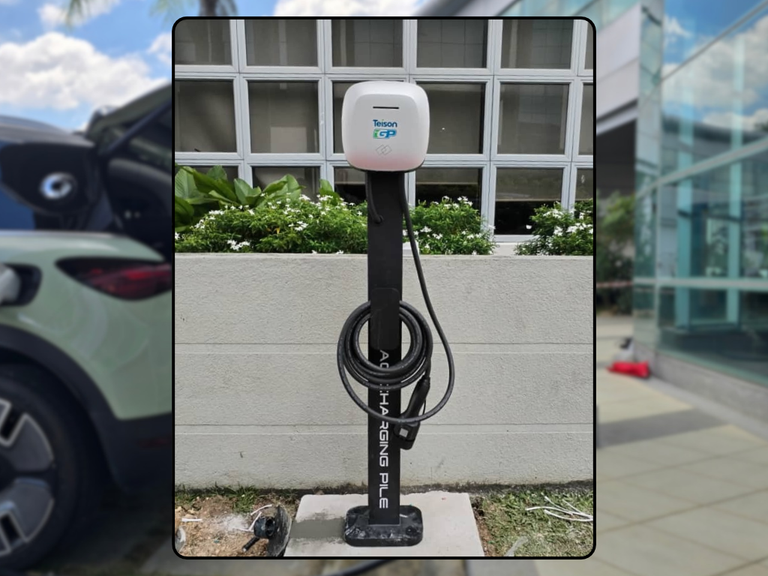
The wallbox on the wall is only the visible part of an EV charging system.
Much of the safety infrastructure sits behind it.
And normally nobody thinks about those components when everything is working properly.
That is how electrical safety should be.
Quiet.
Predictable.
Reliable.
But EV Owners Should Not Panic
I also want to be very clear about this.
One serious incident should not lead us to conclude that home EV charging is inherently unsafe.
Nor should EV owners suddenly become afraid to charge their vehicles at home.
Thousands of Malaysians charge EVs at home every day.
The right response is not panic.
The right response is to make sure your charging system has been properly installed and that you understand what is supplying it.
If you already have a home charger, take this opportunity to ask some basic questions.
Do you know who installed it?
Was the electrical work carried out under a properly registered electrical contractor and competent person?
Does your charger have a dedicated final circuit?
Do you know what cable and protection devices were installed?
Was the existing electrical system assessed?
Was the completed installation tested?
If you do not know the answers, that does not automatically mean your installation is unsafe.
It simply means this may be a good time to find out.
Please Do Not Turn This Into Brand Blaming
Another thing I hope the EV community can avoid is immediately turning this into speculation about vehicle brands or charger brands.
At this point, we simply do not have the evidence.
People may begin circulating photographs and asking:
“What car was it?”
“What charger was used?”
“Who installed it?”
“Was the charger original?”
“Was the wiring compliant?”
Those are legitimate questions for investigators.
But they are questions, not answers.
Until an official investigation establishes the origin and cause of the fire, we should be extremely careful about accusing any manufacturer, charger supplier, installer or homeowner.
There may eventually be important lessons for the entire industry from this case.
But those lessons will only be useful if they are based on evidence.
We Will Patiently Wait for the Official Findings
From Innovative Green Power’s perspective, this is a case we will follow very closely.
Not because we are looking for somebody to blame.
And certainly not because we want to use somebody else’s misfortune to promote ourselves.
We want to understand what happened.
Was the initiating failure associated with the vehicle?
The EV battery?
The charging equipment?
The connector?
The electrical installation?
A protection failure?
A connection fault?
Or something completely unrelated that simply occurred while the vehicle happened to be charging?
We do not know.
So we will wait.
When the relevant authorities complete their investigation and more technical information becomes available, we can then discuss the findings properly and, most importantly, understand whether there are lessons that EV owners, installers, charger manufacturers and the wider industry can learn from.
That is the responsible approach.
One Thing Does Not Need to Wait
We may need to wait for the cause of this particular fire.
But we do not need to wait to take electrical safety seriously.
If you are planning a home EV charger installation, make sure the installation is properly assessed and designed.
If you already have one and you have doubts about the installation, have it inspected by a competent professional.
Do not make modifications simply because someone says, “It should be okay.”
Do not bypass protection because something keeps tripping.
Do not increase electrical capacity without understanding what the rest of the system can safely carry.
And do not assume that because a charging system has worked for months or years, every part of the installation must automatically be correct.
Electrical safety is about reducing risk before something happens.
Final Thoughts
For years, we have spoken about EV charging safety because we know what electrical systems are capable of when something goes wrong.
We never wanted a house fire to become the example that makes people listen.
Today, a Malaysian family is dealing with the aftermath of exactly such a devastating event, and our first concern should be for them.
Thankfully, nobody was injured.
For now, the Fire and Rescue Department’s preliminary information associates the incident with an EV that was being charged, but the information currently available does not establish the detailed technical root cause4.
So we will not speculate.
We will not point fingers.
We will not sensationalise somebody else’s loss.
We will patiently wait for the authorities to complete their investigation.
And when the facts become available, we should study them carefully — not to decide who was “right,” but to understand what can be done better so that another family does not have to experience the same thing.
Until then, our message remains exactly what it has always been:
EV charging should be convenient. It should be reliable. But above everything else, it must be safe.
Let our obsession with quality protect your safety.
Because when it comes to EV charging and electrical systems, there is no room for compromise.
Innovative Green Power Sdn. Bhd.
Additional Resource Links
**Bomba