A Standards-Based Checklist for EV Owners
By Alvin Wong, CEO of Innovative Green Power Sdn. Bhd.
As EV adoption grows, many Malaysian EV owners ask a simple but important question:
“How do I know if my home EV charger installation is actually compliant?”
This is a valid concern.
A charger can power on and charge a car — yet still fail to meet Malaysian regulatory and safety standards.
This article provides a clear, standards-based checklist that EV owners can use to assess whether an installation meets the intent of Malaysian regulations and internationally adopted IEC standards.
1. Compliance Is About the Installation, Not Just the Charger
A common misconception is:
“If the charger is certified, the installation must be safe.”
In reality:
- Chargers are products
- Installations are systems
Under Malaysian law, compliance applies to the entire electrical installation, not just the device.
This framework is governed by:
- Electricity Supply Act 1990
- Electricity Regulations 1994
- Suruhanjaya Tenaga (ST) wiring and EVCS guidelines
- MS IEC 60364
2. Checklist Item 1: Dedicated EV Charger Circuit
A compliant installation must provide:
- A dedicated final circuit for the EV charger
- No sharing with sockets or other household loads
This aligns with:
- MS IEC 60364
- IEC 60364-7-722 (EV-specific installations)
The intent is:
- Predictable loading
- Proper protection coordination
- Clear isolation and fault identification
3. Checklist Item 2: Correct Cable Size for Continuous Load
EV chargers are classified as continuous loads.
A compliant installation must therefore:
- Size conductors for continuous current
- Account for installation method and ambient temperature
- Respect voltage drop limits over actual cable length
This requirement comes from:
- IEC 60364-5-52
- MS IEC 60364
- ST Guidelines for Electrical Wiring in Residential Buildings
Cable sizing based purely on “what usually works” is not compliant design.
4. Checklist Item 3: Proper Isolation Near the Charger
A compliant EV charger installation must include:
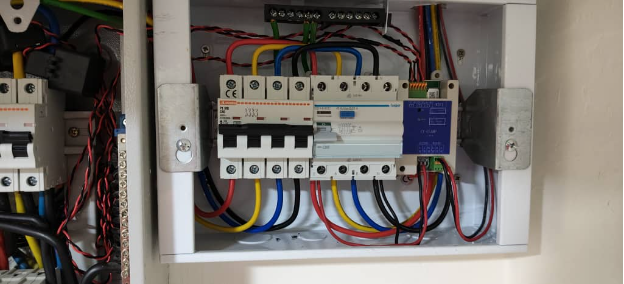
- A local isolator switch
- Clearly associated with the EV charger
- Accessible for maintenance and emergency disconnection
This requirement is derived from:
- Electricity Regulations 1994
- IEC 60364
- IEC 60364-7-722
Software control, app-based shutdown, or unplugging the vehicle does not replace physical electrical isolation.
5. Checklist Item 4: Correct Earth Leakage Protection (No Type AC)
For EV charging circuits:
- Type AC RCDs must not be used
- Protection must be at least Type A
- Additional 6 mA DC leakage protection must be provided
This requirement originates from:
- IEC 60364-7-722
- IEC 62955
- Adopted in Malaysia via MS IEC standards
This ensures upstream RCDs remain effective under EV-specific fault conditions.
6. Checklist Item 5: MCB Selection Suitable for Continuous Load
A compliant installation must:
- Recognise EV charging as a continuous load
- Select MCBs with adequate thermal margin
- Coordinate MCB rating with cable size and installation conditions
This is governed by:
- IEC 60898-1
- MS IEC 60364
Matching current numbers alone is insufficient — long-term thermal behaviour matters.
7. Checklist Item 6: Cable Routing and Segregation
In homes that include:
- Solar ATAP
- Battery Energy Storage Systems (BESS)
- EV chargers
A compliant installation must ensure:
- Proper segregation of AC and DC conductors
- Protection of control and communication cables
- Clear routing, labelling, and identification
This requirement comes from:
- IEC 60364-5-52
- MS IEC 60364
Mixed AC–DC homes make segregation a system-level safety requirement, not an aesthetic choice.
8. Checklist Item 7: Proper Earthing and Bonding
EV chargers rely heavily on:
- Effective earthing
- Low-impedance fault paths
- Reliable bonding continuity
A compliant installation must:
- Verify earth continuity
- Ensure bonding integrity
- Coordinate with existing earthing arrangements
This is governed by:
- MS IEC 60364
- ST wiring guidelines
9. Checklist Item 8: Testing, Commissioning, and Documentation
Compliance does not end at installation.
A competent installer should:
- Test earth continuity
- Verify RCD operation
- Check insulation resistance
- Confirm polarity and loop impedance
- Record basic commissioning results
These steps align with:
- IEC installation verification principles
- ST expectations for competent electrical work
10. Checklist Item 9: Installation by a Competent Person Attached to a Registered Entity
This point is critical and often misunderstood.
Under Malaysian regulations:
- Electrical installation work must be carried out or supervised by a competent person
- That competent person must be formally attached to a registered electrical contracting entity
- Responsibility for compliance lies with both the entity and the competent person
This requirement comes from:
- Electricity Supply Act 1990
- Electricity Regulations 1994
- Suruhanjaya Tenaga registration framework
A competent person operating independently, without formal attachment to an entity:
- Cannot legally take responsibility for installation work
- Cannot provide proper regulatory accountability
- Leaves the property owner exposed if issues arise
Compliance is therefore about:
- The person
- The company
- And the formal linkage between them
11. Why This Checklist Matters
A non-compliant EV charger installation may:
- Function initially
- Charge the vehicle
- Appear acceptable
Yet still:
- Operate outside thermal margins
- Compromise protection systems
- Create long-term electrical risk
Standards exist to prevent slow, invisible failures, not just immediate incidents.
12. How EV Owners Can Use This Checklist
EV owners do not need to memorise regulations.
They can:
- Ask installers how each checklist item is addressed
- Request clarification when answers are vague
- Understand that compliance is about accountability, not just hardware
This shifts decision-making from:
Price-only comparison
to
Safety, competence, and responsibility
Final Takeaway
A compliant EV charger installation is not defined by a single device or a single certificate.
It is defined by:
- Proper system design
- Correct application of standards
- Clear regulatory accountability
For Malaysian homes:
Compliance exists only when both the competent person and the registered entity stand behind the installation.
Safe and Reliable EV Charging Systems, one at a time.
WhatsApp us: https://wa.me/60125954786